Loading Motifs…
STANDALONE MARKETING PLAY / PAY
Set the trial length from experiments, not benchmarks
The number of free days before the first charge changes who starts, who pays and when. Benchmarks say longer trials convert better; the randomised experiments point the other way.
7 days beat 30 and beat 3Two randomised experiments: 15.44% vs 14.63% subscribed with 7 vs 30 days (software firm, 101,024 held-out users); 0.445% vs 0.368% converted over two years with 7 vs 3 days (image editor, 680,588 users). Different businesses — not a tested optimum.
7 days beat 30 and beat 3in two randomised experiments
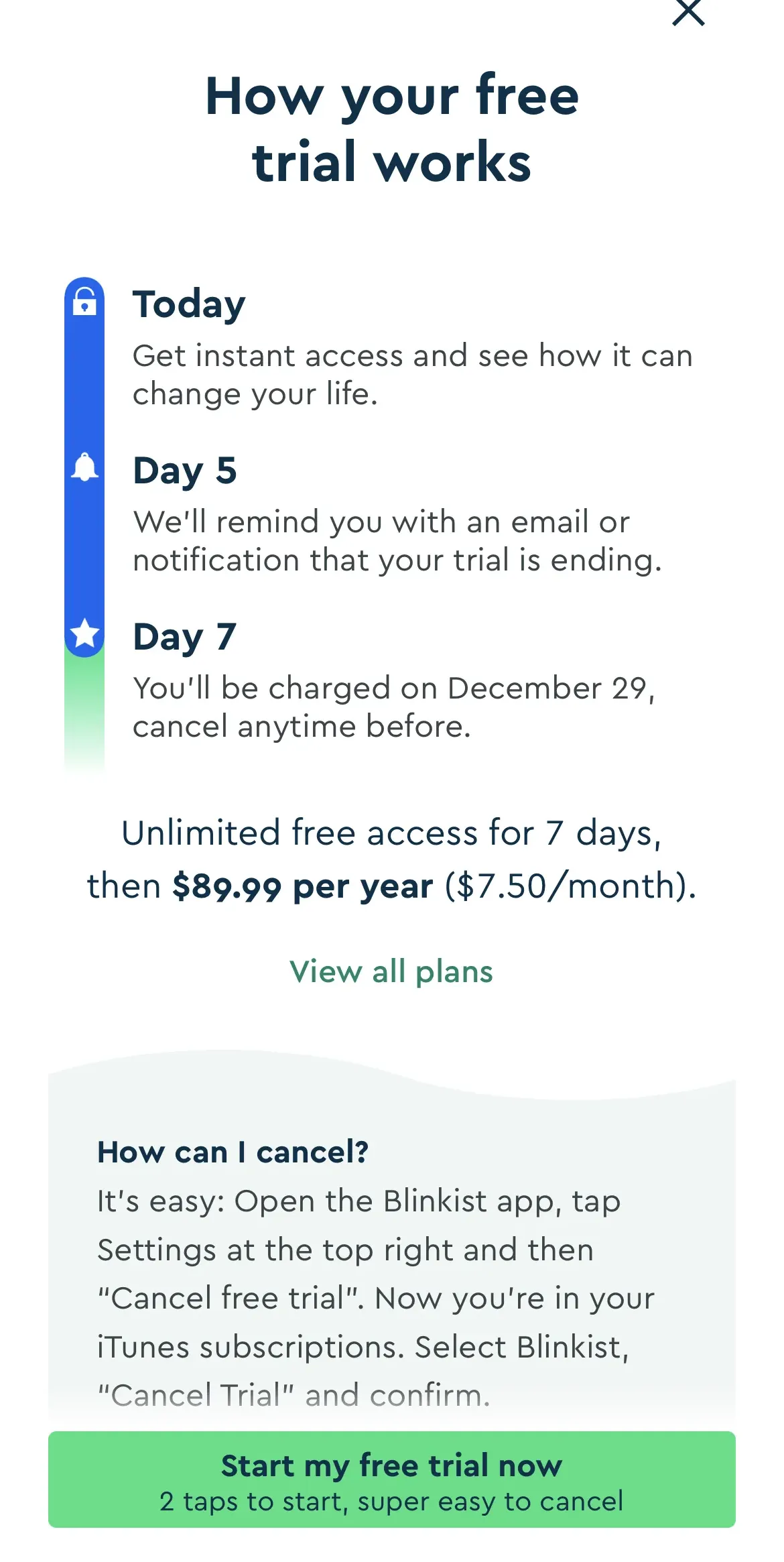
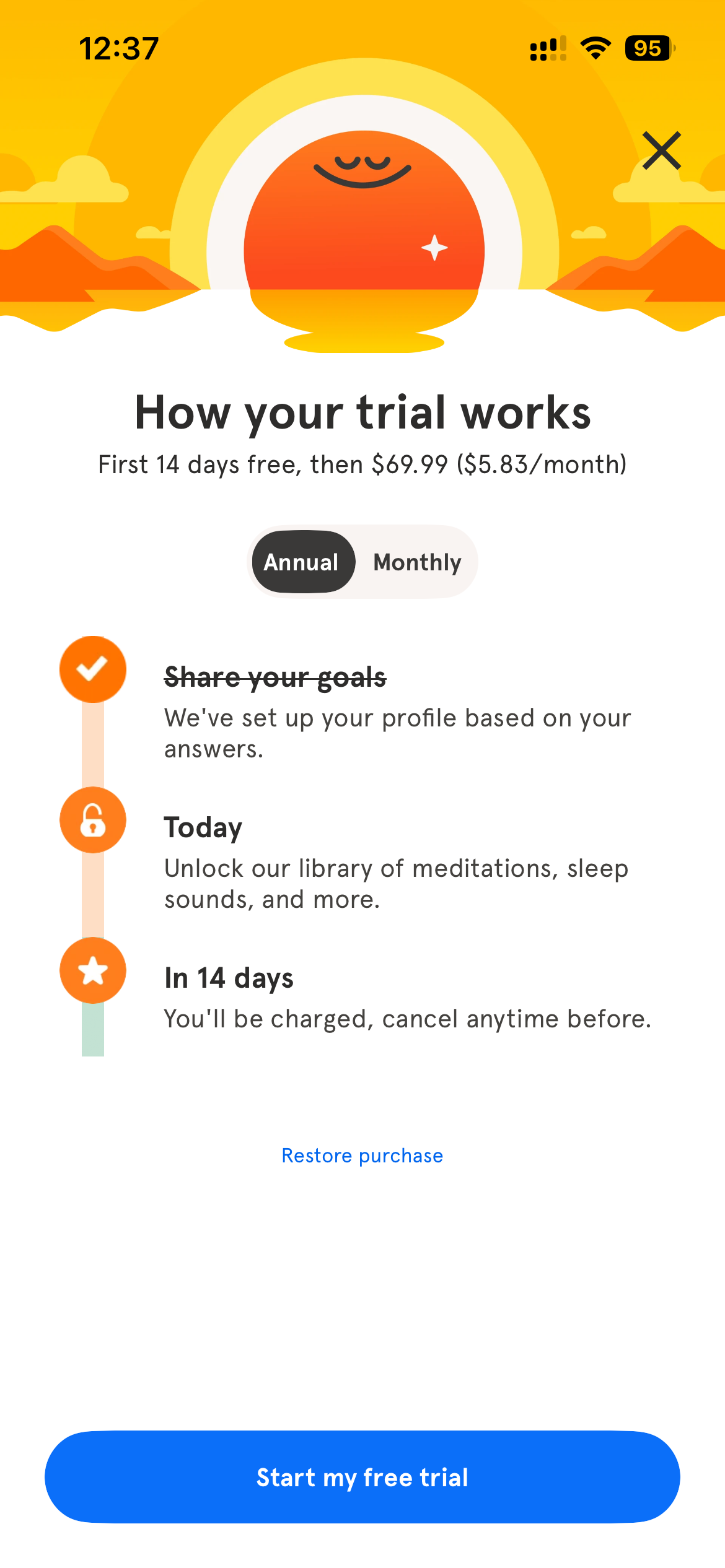
Product screens: Blinkist via Adapty ↗ · Headspace via PaywallScreens ↗. Screens illustrate the product; the number is sourced in the evidence below.
SOURCED
Built from published experiments and company reports across several products. Nobody has checked the screens on a dated day, so read each number with the caveat printed beside it.
THE PLAY
One move, with enough context to use it well.
The number of free days before the first charge changes who starts, who pays and when. Benchmarks say longer trials convert better; the randomised experiments point the other way.
Firms have no consensus on trial length: a short trial limits free-riding and the cost of non-paying users, while a long one can build engagement, switching costs and learning (Yoganarasimhan, Barzegary and Pani).
This play is not tied to a full playbook. Use it for this decision alone.
THE EVIDENCE
6 sourcesWhat the research does, and does not, establish.
At a software firm, a 7-day trial produced more subscriptions than the 30-day incumbent.
STRONGWhat it does not show Figures are from the 2020 arXiv version; the published 2023 version was read as an abstract only (S2), which reports a 6.8% gain for the personalized policy. The firm is anonymous and near-monopolistic in its category; the authors note the average effect of trial length is small next to other factors. Personalized-policy figures are counterfactual estimates, not deployed results.
Design and Evaluation of Personalized Free Trials Yoganarasimhan et al. · 2020
At a freemium image editor, a 7-day trial beat the original 3-day trial.
STRONGWhat it does not show Rates are per registered user; under 1% of new users started any trial, so the absolute differences are small. The trial request page design differed between arms, so the adoption effect includes the page as well as the length. Table 1 of the paper defines trial adoption as converting at the end of the trial, which contradicts the text; the text definition is used here. The abstract dates the experiment 2023-2024 while the methods give 2022-2024. Published in Frontiers in Psychology; the firm is anonymous and its prices are not given.
Longer or shorter? A large-scale randomized field experiment on the impact of free trial duration on sustainable user conversion in the Freemium model Zhang and Duan · 2025
BORROW WITH INTENTION
A good fit starts with good judgment.
Where it can help
- Longer trials: task-oriented rather than creativity-oriented features, and high-individualism markets (image-editor experiment)
- Longer trials: experienced users of the software rather than beginners or students (software-firm experiment)
- Any product that can run a randomised length test and measure paid conversion months after the trial
Use the play for this decision alone, or combine it with an existing product strategy after checking for conflicts.
Where to be careful
- Longer trials did worse where features were creative and exploratory, in high long-term-orientation markets and lower-GDP regions (image-editor experiment).
- Longer trials did worse for beginners and students (software-firm experiment).
- Avoid a longer trial if users postpone the activation behaviour during the extra days instead of completing it.
- On the App Store, a free trial can only be 3 days, 1 or 2 weeks, 1, 2, 3 or 6 months, or 1 year, and each person can redeem one introductory offer per subscription group.
HOW THIS GOES WRONG
Ways a correct-looking build still does harm.
A longer trial can raise trial starts while lowering conversions, so trial starts or trial-to-paid read alone can move opposite to paying users per new user.
Shortening a trial, especially alongside a price increase, may shift unhappy payers into refunds that offset the conversion gain.
In a freemium product, a measurement window that ends with the trial misses delayed conversion months later.
A per-user length policy can do worse than one uniform length: at the software firm, policies built on linear regression and random forests did worse than giving everyone 7 days.
THE BUILD RECORD
This page helps you decide. The record helps you build.
In the record, not on this page
- The screen spec: the mechanism, what goes on screen, and what it should change
- 6 findings in full, with every number the source gives
- 3 ways to adapt it to your product
Plus everything above, as plain text for your coding agent, with a short instruction on top: check the fit, say what the evidence doesn’t support, and adapt it rather than copy it. Paste it and you get an answer, no prompt to write.
Three randomised experiments, RevenueCat's benchmark and company accounts from Mimo and an unnamed wellness app · evidence reviewed 25 September 2026.
NEED A COMPLETE DIRECTION?
A play solves one problem. A playbook connects the whole system.
Explore company-inspired strategies that connect your product, experience, and growth.
Browse the playbooks ↗