Loading Motifs…
STANDALONE MARKETING PLAY / FIRST VALUE
Ask after signup, and say what the answer changes
Put the one personalisation question inside onboarding, after the account exists, and say what the answer will improve. Asked in the middle of signup, the same question cost Pinterest signups.
−30% signupsPinterest's Google signups when a gender question sat between Google sign-in and registration, even as activation rose about 7%. Moved into onboarding with a stated reason, completion rose 11%. Company-reported; relative or absolute not stated.
−30% signupswith a question mid-signup
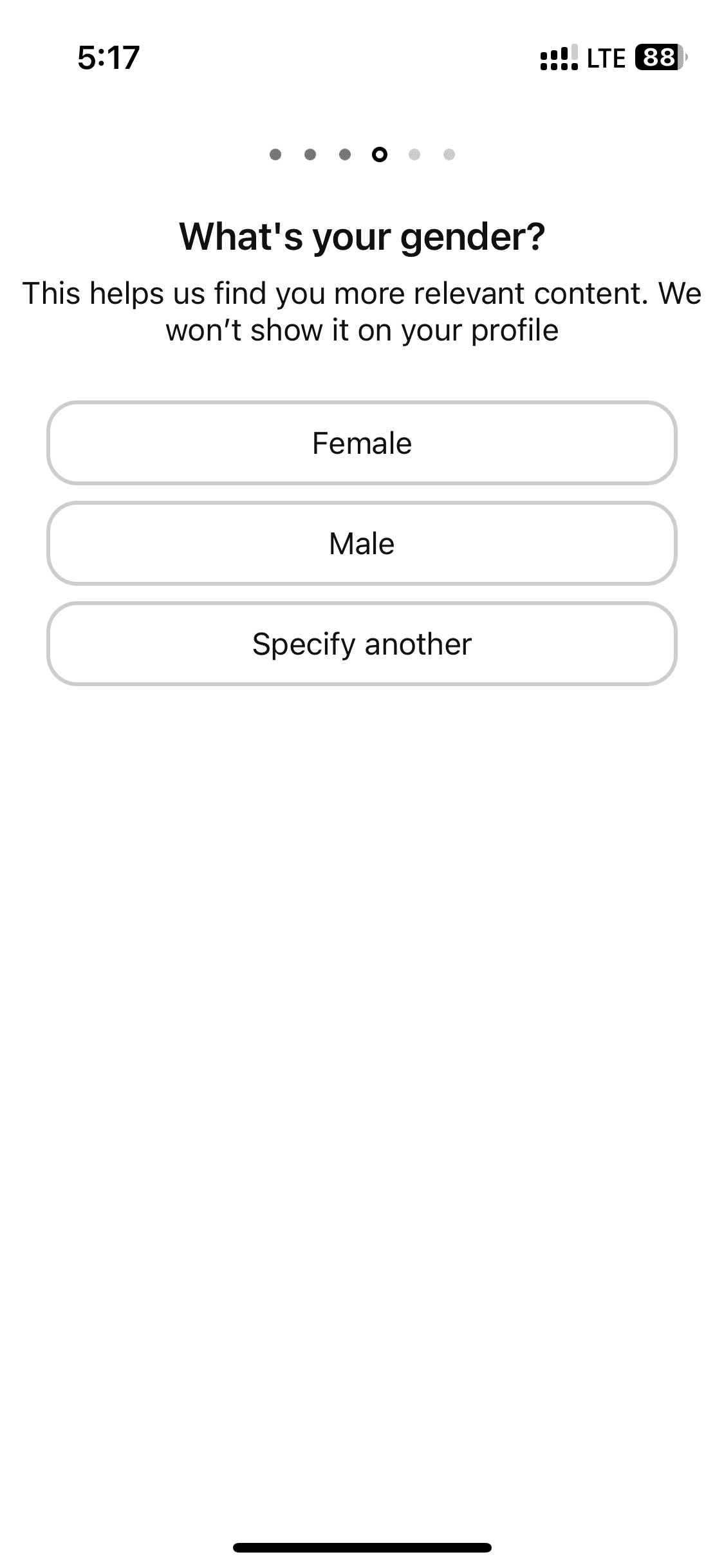
Product screens: Pinterest via Banani ↗. Screens illustrate the product; the number is sourced in the evidence below.
SOURCED
Built from published experiments and company reports across several products. Nobody has checked the screens on a dated day, so read each number with the caveat printed beside it.
THE PLAY
One move, with enough context to use it well.
Put the one personalisation question inside onboarding, after the account exists, and say what the answer will improve. Asked in the middle of signup, the same question cost Pinterest signups.
Recommenders need personal signals that many new users have not given, and people often feel uncomfortable giving them; at Pinterest, gender was missing for a good share of people who signed up with Google (Sophia Feng, Pinterest).
This play is not tied to a full playbook. Use it for this decision alone.
THE EVIDENCE
4 sourcesWhat the research does, and does not, establish.
Asking between Google sign-in and registration cut Pinterest's Google signups.
COMPANY-REPORTEDWhat it does not show Whether the percentages are relative or absolute, the comparison, sample size and period are not stated. The post does not say whether this version explained why gender was asked. Measured drop in signups; the net effect on activated users is not reported.
Exploring effective user signals Sophia Feng · 2018
The same question inside onboarding, with a stated reason, raised completion.
COMPANY-REPORTEDWhat it does not show Whether the 11 percent is relative or absolute is not stated, so it is kept out of structured results. Sample size, baseline, period, significance and randomization are not described; the post calls it an experiment. Position, design and the stated reason changed together, so none is isolated. No activation or engagement figures are given for this version.
Exploring effective user signals Sophia Feng · 2018
Completion rose even for users whose answer Pinterest already had.
COMPANY-REPORTED
BORROW WITH INTENTION
A good fit starts with good judgment.
Where it can help
- Products with a recommendation system that actually uses the answer
- A new-user onboarding flow after signup where a step can be added
- One question, not a series
Use the play for this decision alone, or combine it with an existing product strategy after checking for conflicts.
Where to be careful
- Avoid inserting the step after social sign-in and before the account is created.
- Avoid attaching a justification message to each of a long series of personal-data requests.
- When several questions are asked, the first gets answered more and later ones less.
HOW THIS GOES WRONG
Ways a correct-looking build still does harm.
A stated reason can read as a warning rather than a benefit.
Asking for a sensitive attribute such as gender without offering to decline, clear answer options, or a way to change it later.
If the answer does not visibly change what the user sees, the stated reason stops being true.
THE BUILD RECORD
This page helps you decide. The record helps you build.
In the record, not on this page
- The screen spec: the mechanism, what goes on screen, and what it should change
- 4 findings in full, with every number the source gives
- 3 ways to adapt it to your product
Plus everything above, as plain text for your coding agent, with a short instruction on top: check the fit, say what the evidence doesn’t support, and adapt it rather than copy it. Paste it and you get an answer, no prompt to write.
Pinterest's engineering post on experiments from late 2017, and one controlled experiment on disclosure · evidence reviewed 25 September 2026.
NEED A COMPLETE DIRECTION?
A play solves one problem. A playbook connects the whole system.
Explore company-inspired strategies that connect your product, experience, and growth.
Browse the playbooks ↗