Loading Motifs…
STANDALONE MARKETING PLAY / PAY
Lock everything, or give the core away
Decide how much of the product a new user can use before paying — from a free tier with a locked premium slice to a hard paywall with nothing past onboarding. Conversion and growth move in opposite directions.
10.7% vs 2.1%Median share of installs paying within 35 days: hard-paywall apps vs freemium apps in RevenueCat's 2025 data. Different apps that chose their own model — not a test of switching.
10.7% vs 2.1%of installs paying within 35 days
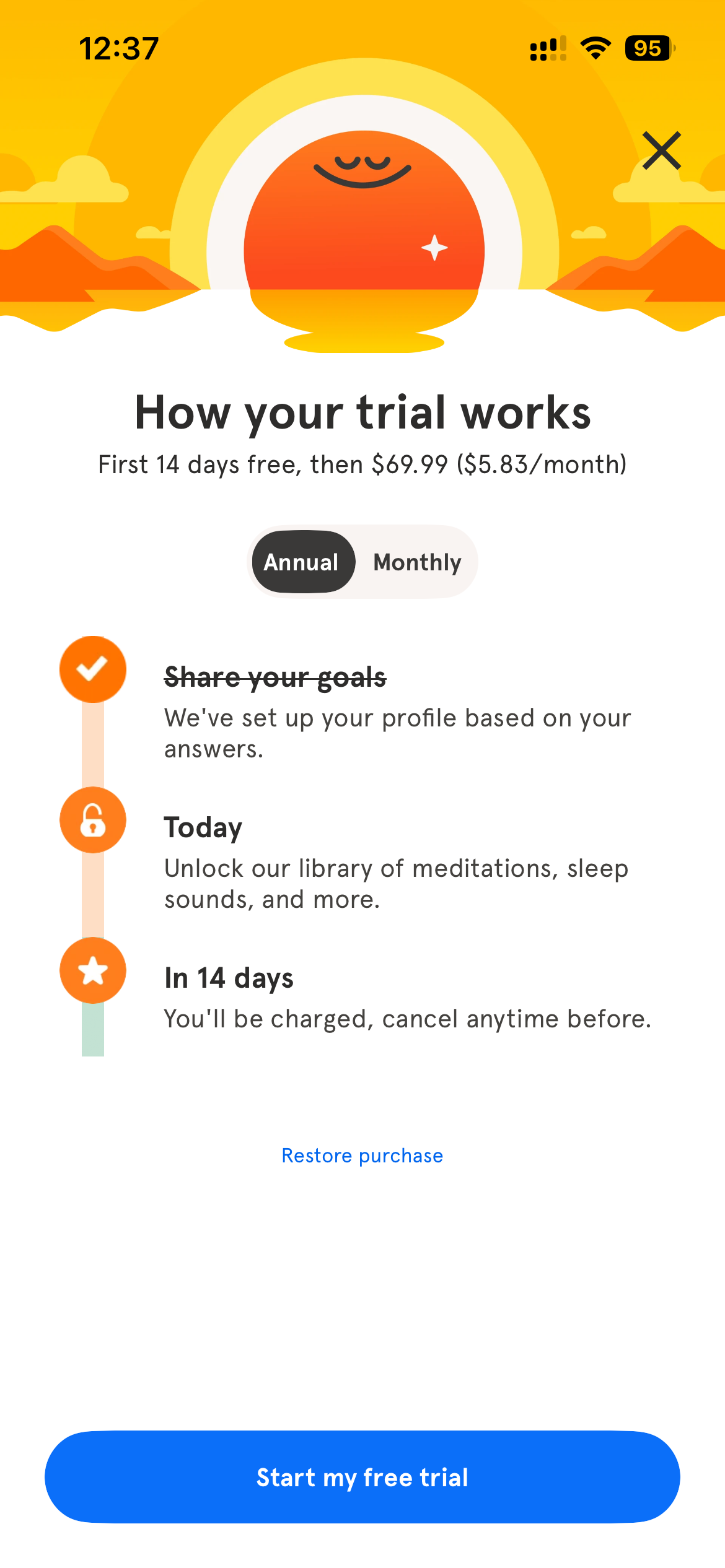
Product screens: Headspace via PaywallScreens ↗. Screens illustrate the product; the number is sourced in the evidence below.
SOURCED
Built from published experiments and company reports across several products. Nobody has checked the screens on a dated day, so read each number with the caveat printed beside it.
THE PLAY
One move, with enough context to use it well.
Decide how much of the product a new user can use before paying — from a free tier with a locked premium slice to a hard paywall with nothing past onboarding. Conversion and growth move in opposite directions.
A generous free tier can let people keep coming back to one free thing without ever seeing why to pay, as Headspace found; a hard paywall can slow growth, as Opal found (Headspace and Opal, on the Sub Club podcast).
This play is not tied to a full playbook. Use it for this decision alone.
THE EVIDENCE
7 sourcesWhat the research does, and does not, establish.
Locking Headspace's whole library behind a trial lifted paid subscribers.
COMPANY-REPORTEDWhat it does not show Staff account on a vendor podcast; no numbers, sample size, window or confidence interval. Whether "lift" is relative is not stated.
How Headspace Optimized Revenue by Gating Content — Shreya Oswal and Keya Patel, Headspace Sub Club Podcast (RevenueCat)
Headspace converted more users as it locked more content.
COMPANY-REPORTEDWhat it does not show Described as tests and experiments; the design, randomization and figures are not given. A free trial and price tests were introduced in the same period and rolled out together at the end of 2019.
How Headspace Optimized Revenue by Gating Content — Shreya Oswal and Keya Patel, Headspace Sub Club Podcast (RevenueCat)
One app's move to freemium more than halved subscriber conversion.
COMPANY-REPORTED
BORROW WITH INTENTION
A good fit starts with good judgment.
Where it can help
- Hard paywall: when the outcome that matters is download-to-paid within 35 days and revenue per install within 60 (RevenueCat's cross-app medians)
- Hard paywall: effortful habits where early commitment makes trial users explore more deeply (Headspace's account)
- Freemium: when growth depends on free users recommending the app
Use the play for this decision alone, or combine it with an existing product strategy after checking for conflicts.
Where to be careful
- Avoid a hard paywall when growth depends on segments that would not pay upfront, such as the students Opal reached after going free.
- Avoid it when total usage — and any advertising revenue tied to it — matters alongside subscriptions: at the NYT, less free access cut reading by 9.9% while subscriptions rose.
- The same conversion figure is labelled differently across sources (download-to-paid, trial-to-paid, paid share of monthly actives), so check the definition before comparing.
HOW THIS GOES WRONG
Ways a correct-looking build still does harm.
Conversion-rate comparisons hide the top of the funnel: Opal's paying share fell while daily users grew. Whichever you track decides which way the change looks.
Locking content existing free users already rely on is a different change from locking it for new users; Headspace handled the two groups separately and paid for the transition with a discount.
A free tier too generous leaves no reason to upgrade; one too thin loses users before they form a habit.
THE BUILD RECORD
This page helps you decide. The record helps you build.
In the record, not on this page
- The screen spec: the mechanism, what goes on screen, and what it should change
- 7 findings in full, with every number the source gives
- 3 ways to adapt it to your product
Plus everything above, as plain text for your coding agent, with a short instruction on top: check the fit, say what the evidence doesn’t support, and adapt it rather than copy it. Paste it and you get an answer, no prompt to write.
Company accounts from Headspace, Opal and two advisor clients, RevenueCat's benchmark, and one quasi-experiment at the New York Times · evidence reviewed 25 September 2026.
NEED A COMPLETE DIRECTION?
A play solves one problem. A playbook connects the whole system.
Explore company-inspired strategies that connect your product, experience, and growth.
Browse the playbooks ↗