
2 Strategies Fitness Apps Use to Show People Their Progress
Stop Giving Everyone the Same Goal
Copies it for your coding agent, which checks the fit and builds it · The whole record, as markdown
Daily steps, between-arm differences in three small trials against a fixed 10,000-step goal or no treatment (Cal Fitness, Walkadoo, Adams 2013). In Cal Fitness both arms fell; adaptive fell less.
Direct research included. Read the findings and limits.
- 3 entries · direct research
- 2 entries · related research
From Cal Fitness, WalkIT, Walkadoo, Adams et al.
Overview
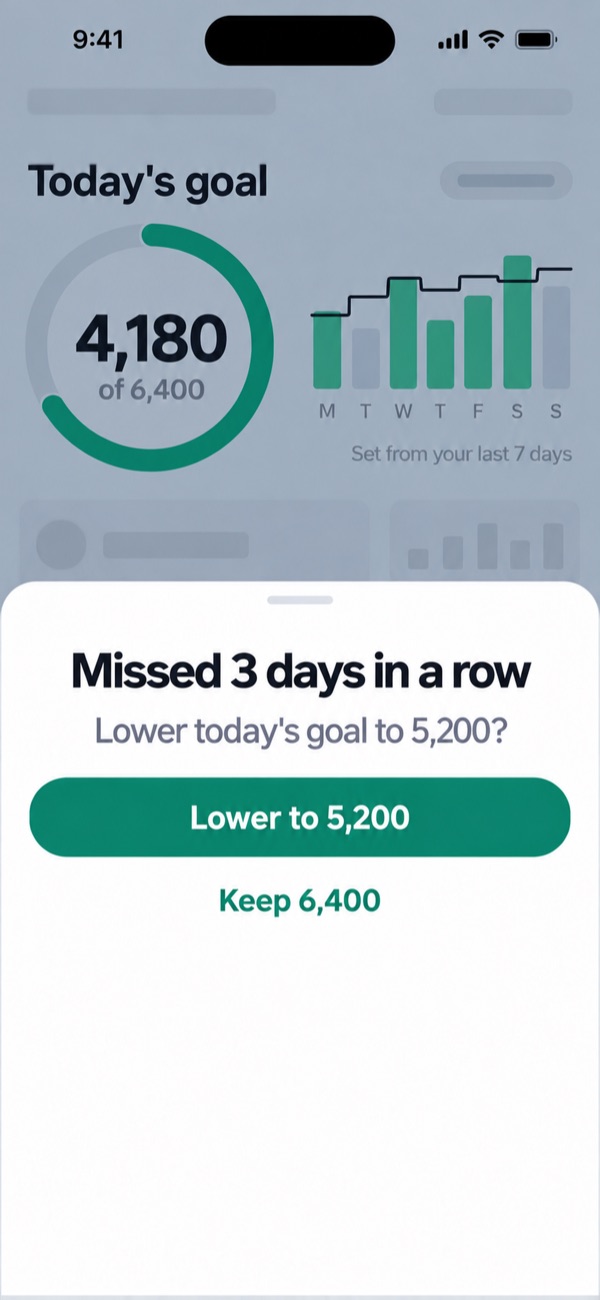
Compute each day's target from the person's own recent activity, so it rises and falls with them instead of sitting at 10,000 steps. Five controlled trials favour it: mostly by slowing the decline, not by a bigger start.
A fixed goal like 10,000 steps is too high for some people and too easy for others, and can discourage people so that activity stays flat or falls (Zhou et al.; Adams et al.).
Fits when
- Sedentary or low-to-somewhat active users, under 10,000 steps a day
- Programmes judged at four months or a year, not by the first increase
- Getting inactive people to do any activity on a given day
Evidence & sources 5 entries
Read sources here with all-access, or get every source when you copy this play.
Good to knowFit and evidence notes
- Fit to consider
- Needs daily activity recorded without manual entry, and a baseline of recent days before the first goal.
- About the evidence
- Adams 2013 and Walkadoo bundled the adaptive goal with rewards, praise, points and community; neither result belongs to the goal alone.
Copy includes 2 more limitations, 4 failure modes, the full evidence, and adaptation guidance.
Will this help what you’re building?
Private to Motifs. It helps decide what to research next.