Loading Motifs…
STANDALONE MARKETING PLAY / RETURN
Rank people weekly, in small leagues
Put each user in a small weekly leaderboard ranked on points from normal use; top finishers move up a tier, bottom finishers move down. Duolingo reports big engagement gains — and its users report stress and unfair demotions.
+17%Overall learning time after Duolingo launched leagues, as reported by its former head of product; Duolingo's S-1 says “almost 20%”. Company-reported with the basis unstated, and not tied to a test.
+17%learning time after leagues launched
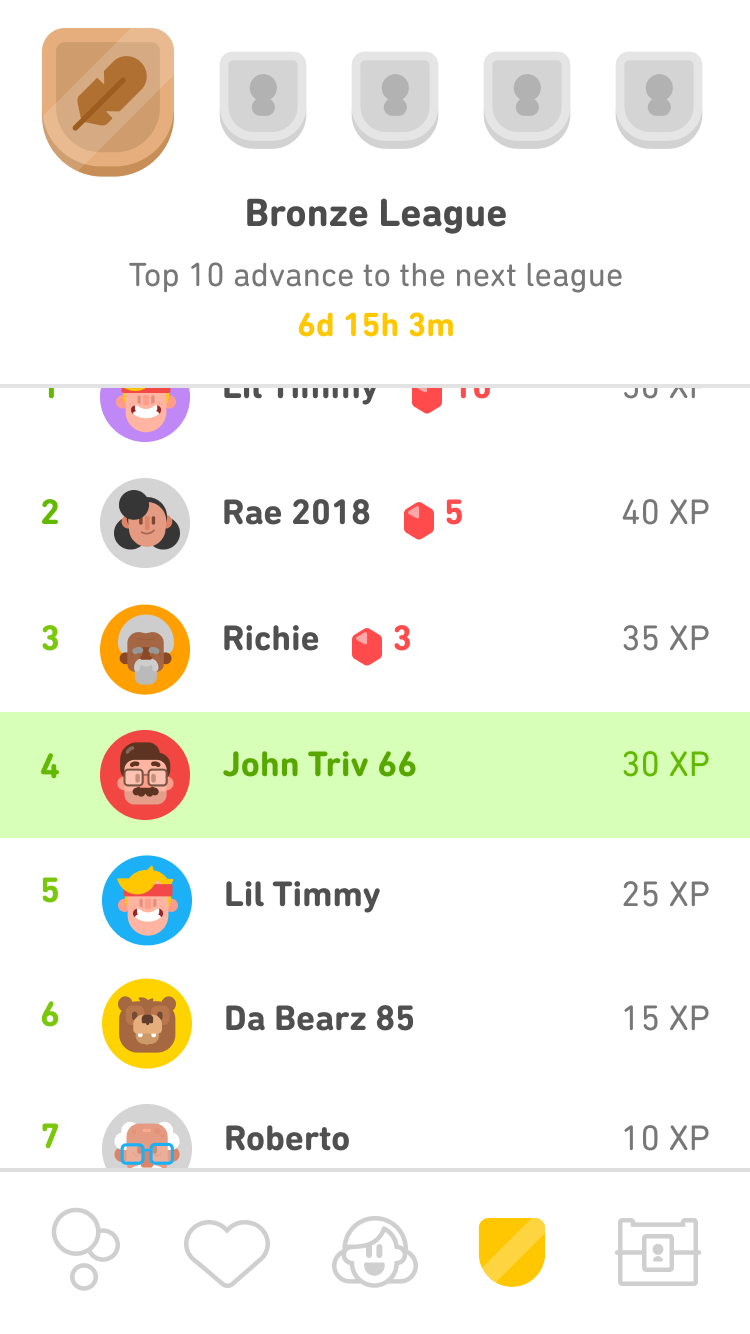
Product screens: Duolingo via Duolingo ↗. Screens illustrate the product; the number is sourced in the evidence below.
SOURCED
Built from published experiments and company reports across several products. Nobody has checked the screens on a dated day, so read each number with the caveat printed beside it.
THE PLAY
One move, with enough context to use it well.
Put each user in a small weekly leaderboard ranked on points from normal use; top finishers move up a tier, bottom finishers move down. Duolingo reports big engagement gains — and its users report stress and unfair demotions.
In a mature product many users' friends are no longer active, so competing against people with similar recent engagement can matter more than competing against friends (Jorge Mazal, former head of product at Duolingo — his hypothesis, which he says testing at Zynga bore out).
This play also appears inside the Duolingo playbook. You can still use it independently.
THE EVIDENCE
3 sourcesWhat the research does, and does not, establish.
After leagues launched, Duolingo reports more learning time and three times as many highly engaged learners.
COMPANY-REPORTEDWhat it does not show The design behind these figures is not stated. Duolingo describes Leaderboards as having been launched through A/B tests (S4, S5), but no source ties the 17% or the tripling to a test. Sample size, baseline, confidence interval and measurement window are not reported. Written by a former executive in a growth retrospective.
How Duolingo reignited user growth Jorge Mazal · 2023
In an iOS experiment, leagues raised lessons started and completed.
COMPANY-REPORTEDWhat it does not show No effect sizes, sample size, duration or confidence intervals are given in the text; the chart in the post was not readable as data. Lessons completed is an activity measure, not a learning outcome.
Improving Duolingo, one experiment at a time Lavanya Aprameya · 2020
Duolingo users describe league stress, unfair demotion and cheating.
SUPPORTING
BORROW WITH INTENTION
A good fit starts with good judgment.
Where it can help
- Mature products where many users' friends are no longer active
- Grouping competitors by recent engagement rather than friendship
- Enough weekly active users to fill groups of about 30 at each activity level
Use the play for this decision alone, or combine it with an existing product strategy after checking for conflicts.
Where to be careful
- Avoid groups that mix users with different levels, subjects and goals.
- Avoid rules that can demote someone who met the daily goal the product itself suggests.
- When the only way out is a private profile, users who find it stressful lose other social features too.
HOW THIS GOES WRONG
Ways a correct-looking build still does harm.
Points earned by repeating easy content or cheating let users climb without doing the intended activity, and users copy cheating once they suspect it.
Time or points can rise while the activity loses value to the user; engagement metrics alone will not show it.
Demotion takes something away for relative effort, so a good week can still end in a loss.
THE BUILD RECORD
This page helps you decide. The record helps you build.
In the record, not on this page
- The screen spec: the mechanism, what goes on screen, and what it should change
- 3 findings in full, with every number the source gives
- 3 ways to adapt it to your product
Plus everything above, as plain text for your coding agent, with a short instruction on top: check the fit, say what the evidence doesn’t support, and adapt it rather than copy it. Paste it and you get an answer, no prompt to write.
Duolingo's own accounts, and one qualitative study of Duolingo users; no independent test of leagues against no leagues · evidence reviewed 25 September 2026.
NEED A COMPLETE DIRECTION?
A play solves one problem. A playbook connects the whole system.
Explore company-inspired strategies that connect your product, experience, and growth.
Browse the playbooks ↗